Why beetroot works.
Beetroot isn't a trend — it's one of the most researched functional foods for circulation and endurance. Here's the simple version of what's happening inside.

From root to nitric oxide.

Dietary nitrates
Beetroot is naturally rich in dietary nitrates — the raw material your body uses to make nitric oxide.
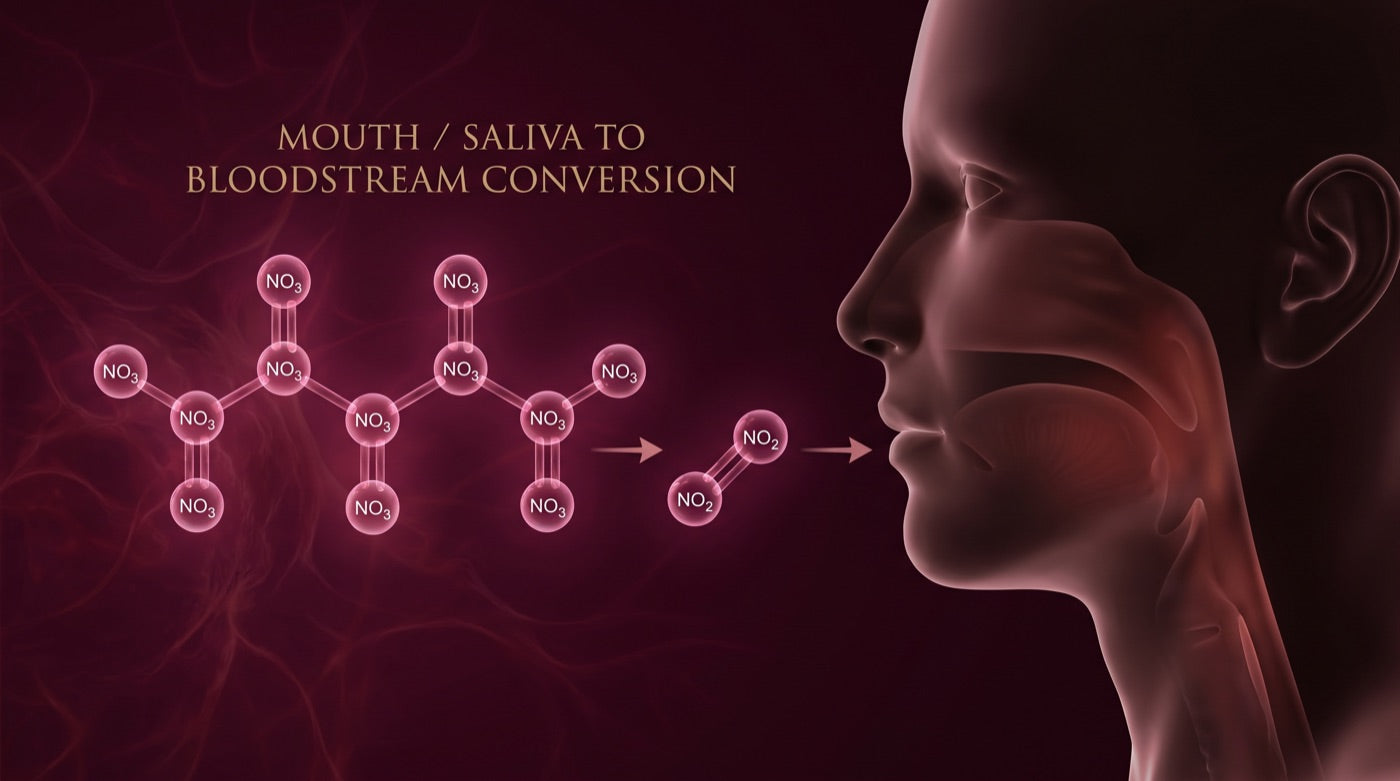
Converted in the body
Nitrates are converted to nitrites by bacteria in your mouth, then to nitric oxide in the bloodstream.
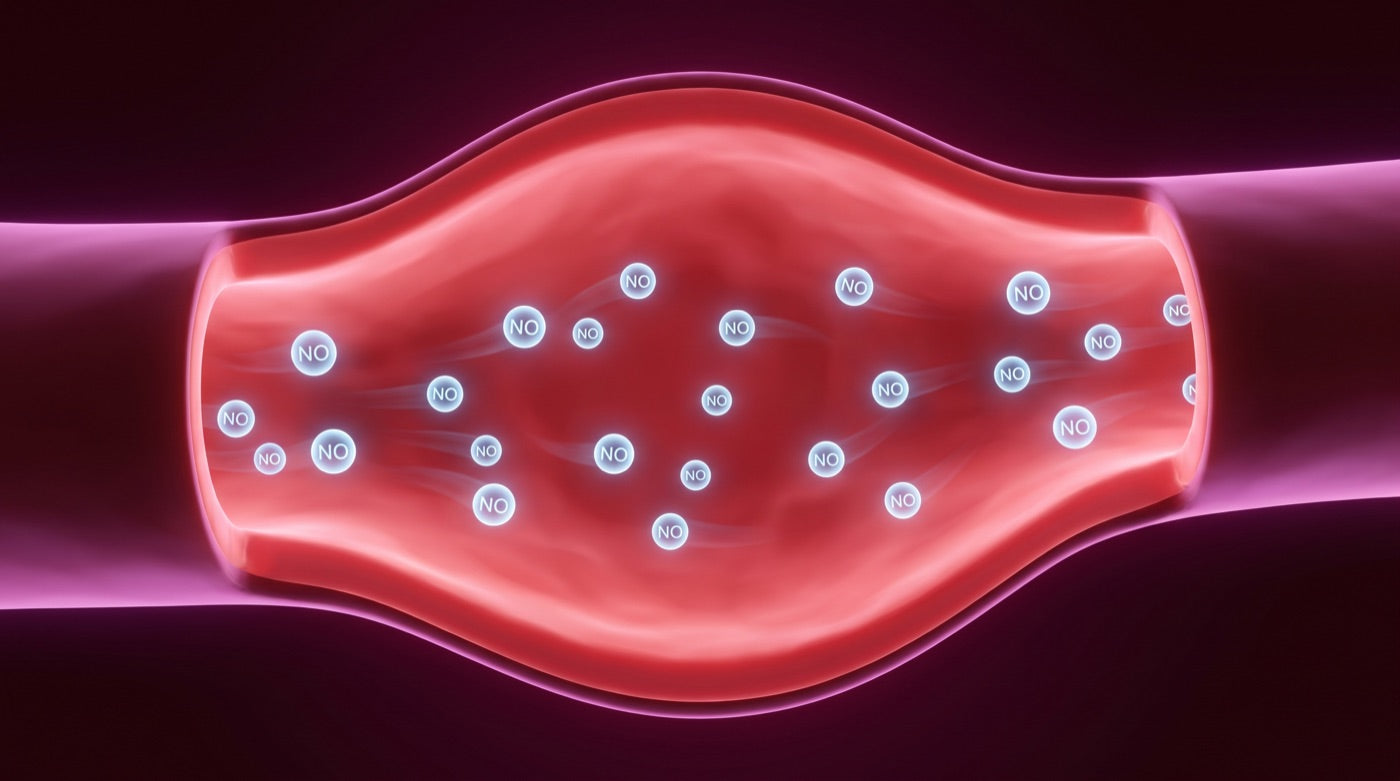
Vessels relax
Nitric oxide helps blood vessels relax and widen, supporting healthy circulation and oxygen delivery.*
How beetroot supports blood flow.
The effect runs through what scientists call the nitrate–nitrite–nitric oxide (NO) pathway. Here's each step, from the scoop to the blood vessel.
Nitrate goes in
Beetroot is one of the richest dietary sources of inorganic nitrate (NO₃⁻). When you drink a scoop, that nitrate is absorbed in the gut and enters your bloodstream within about an hour.
The enterosalivary loop
Up to a quarter of that nitrate is drawn back into your saliva. Friendly bacteria on the tongue then reduce it to nitrite (NO₂⁻) — a step your own cells can't do, which is why oral bacteria matter to the whole process.
Nitrite becomes nitric oxide
Swallowed nitrite is converted into nitric oxide (NO), especially where oxygen is low or demand is high — such as hard-working muscle. This makes the pathway a natural back-up route for producing NO on demand.
Vessels relax (vasodilation)
NO signals the smooth muscle lining your blood vessels to relax. The vessels widen — a process called vasodilation — which lowers resistance to flow.*
Better flow & oxygen delivery
Wider, more relaxed vessels mean blood — and the oxygen it carries — moves more efficiently. In studies this has been linked to support for healthy blood pressure and to improved efficiency during exercise, since muscles get oxygen at a lower energy cost.*
Because the effect is driven by how much nitrate you actually take in, a token amount of beetroot does little. Research typically uses a substantial nitrate dose taken consistently — which is why we pack 4,500mg per scoop and make it taste good enough to drink every day. See references below.

4,500mg, not a pinch.
Many beetroot products use just enough to list it on the label. We use a full 4,500mg of organic beetroot per scoop — a meaningful amount that reflects the way beetroot is actually studied.
We also add Vitamin C and Niacin (B3) to round out the formula, and flavor it with real berry so you'll actually look forward to it.
Shop Beetroot PowderThe effect is dose-dependent.
Beetroot works through the nitrate it delivers — and research shows the response tracks with the dose. Put simply: the more nitrate that reaches your blood (up to a point), the bigger the rise in plasma nitrite that drives nitric oxide.* A small serving may not move the needle at all.
Enough to print "beetroot" on the label, but often below the amount used in studies that show a measurable effect.
A meaningful, full dose that reflects the way beetroot is actually studied — about 3.5× a typical low-dose product.
Studies giving larger nitrate doses produced greater and longer-lasting increases in plasma nitrite than smaller doses — the marker most tied to nitric oxide availability.*
Trials using very low nitrate doses often show little to no measurable effect, while higher doses are where performance and blood-flow responses tend to appear.*
Dose comparison is illustrative of typical low-dose beetroot products. Individual absorption varies with oral bacteria, diet, and timing. See references.
It helps the nitric oxide last.
Vitamin C doesn't help you "digest" beetroot — its role is smarter than that. As a strong antioxidant, it helps protect nitric oxide from being broken down by reactive oxygen species, so more of the NO your body produces stays available to do its job.*
Research also shows Vitamin C can help drive the conversion of nitrite into nitric oxide, and supports the health of the endothelium — the vessel lining where nitric oxide actually acts. Pairing it with beetroot's nitrate is a deliberate, complementary choice.*

A little root, a lot of upside.
Healthy blood flow*
Supports circulation and nitric oxide production.
Athletic performance*
A pre-workout favorite for stamina and endurance.
Natural energy*
Clean, sustained energy without caffeine or stimulants.
*These statements have not been evaluated by the Food and Drug Administration. This product is not intended to diagnose, treat, cure, or prevent any disease. Educational content only, not medical advice — consult your physician before beginning any supplement.
Beetroot is one of the most-studied functional foods.
Dietary nitrate from beetroot has been examined in hundreds of human trials. Here's a plain-language look at three areas researchers have focused on. Effects in studies depend on dose and duration, and results vary between individuals.

Support during hard efforts
Nitrate-rich beetroot juice has been studied for its effect on repeated high-intensity efforts, where it has been associated with improved intermittent exercise performance.*
View study — Wylie et al., 2016 →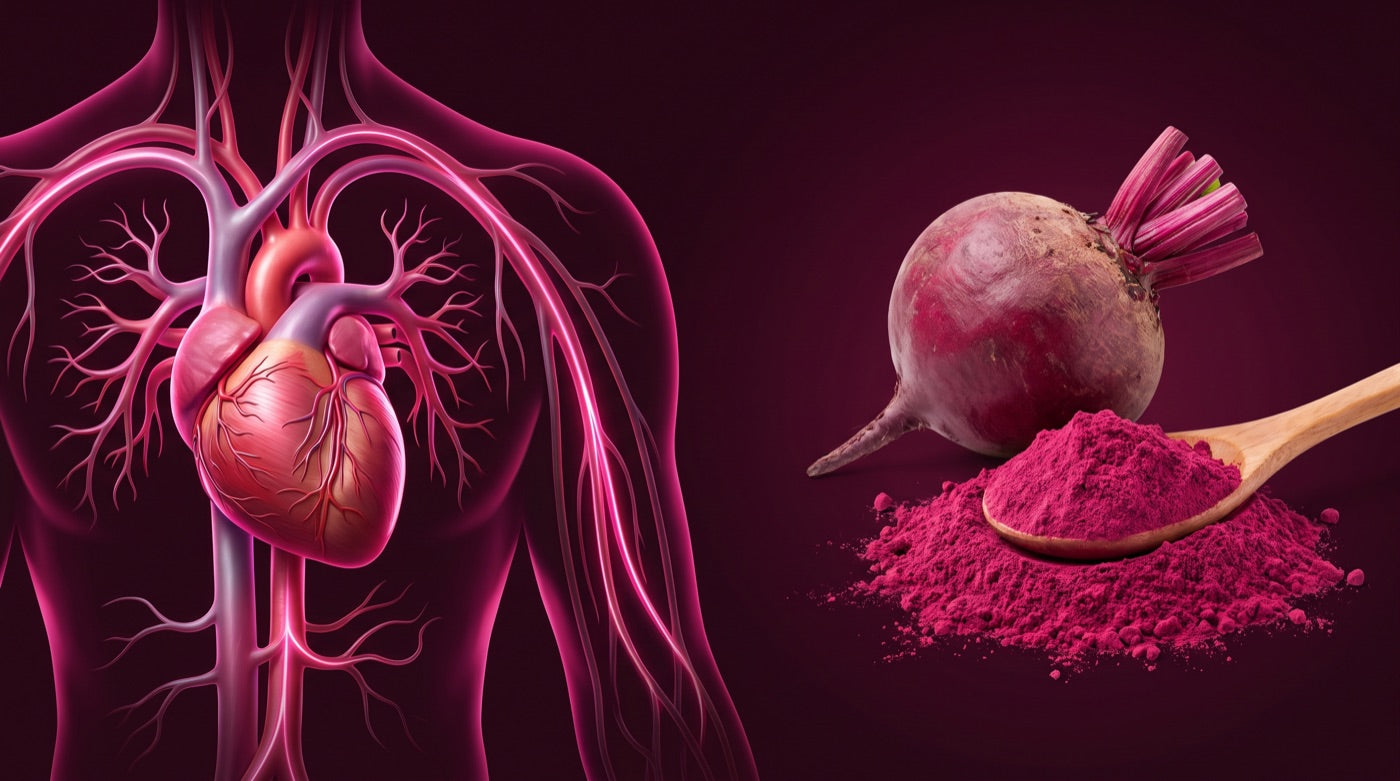
Circulation & more
Reviews of beetroot (Beta vulgaris) describe its nitrates, betalains, and antioxidants and their studied role in supporting cardio-metabolic function.*
View review — Chen et al., 2020 →
Studied in meta-analysis
A 2022 systematic review and meta-analysis found beetroot juice mainly influenced systolic blood pressure, with results depending on dose and duration of intake.*
View meta-analysis — Lipert et al., 2022 →How we turn the science into a supplement.
Studies consistently point to dose mattering. We use a full 4,500mg of organic beetroot per scoop rather than a token amount.
Research suggests benefits tend to build with medium-term, consistent use — so we made a berry flavor you'll actually want every day.
Organic, non-GMO, and third-party lab tested each batch — with added Vitamin C and Niacin (B3) to round out the formula.
The science is in the scoop.
A full 4,500mg of organic beetroot, dosed the way it's actually studied — in a berry flavor you'll want every day. Backed by our 90-day money-back guarantee.

Selected research.
- Wylie, L.J., et al. (2016). Influence of beetroot juice supplementation on intermittent exercise performance. European Journal of Applied Physiology. pubmed.ncbi.nlm.nih.gov/26614506
- Chen, L., et al. (2020). Beetroot as a functional food with huge health benefits: Functional properties of beetroot (Beta vulgaris) in the management of cardio-metabolic diseases. pubmed.ncbi.nlm.nih.gov/31921325
- Lipert, A., et al. (2022). The Effect of Herbal Supplements on Blood Pressure: Systematic Review and Meta-Analysis. Antioxidants, 11(8), 1419. mdpi.com/2076-3921/11/8/1419
- Rammos, C., et al. (2021). The effect of dietary nitrate and vitamin C on endothelial function, oxidative stress and blood lipids in untreated hypercholesterolemic subjects: A randomized double-blind crossover study. Clinical Nutrition. pubmed.ncbi.nlm.nih.gov/33115598
- May, J.M. (2000). How does ascorbic acid prevent endothelial dysfunction? Free Radical Biology & Medicine — reviews how vitamin C helps preserve nitric oxide, including direct reduction of nitrite to NO. pubmed.ncbi.nlm.nih.gov/10924860
*These statements have not been evaluated by the Food and Drug Administration. This product is not intended to diagnose, treat, cure, or prevent any disease. This page is educational and summarizes published research on beetroot and dietary nitrate; it is not medical advice, and individual results vary. Consult your physician before starting any supplement, especially if you are pregnant, nursing, or taking medication.
Put the science to the test.
One berry-flavored scoop a day, backed by our 90-day money-back guarantee.
Shop Beetroot Powder